
★ Covert knife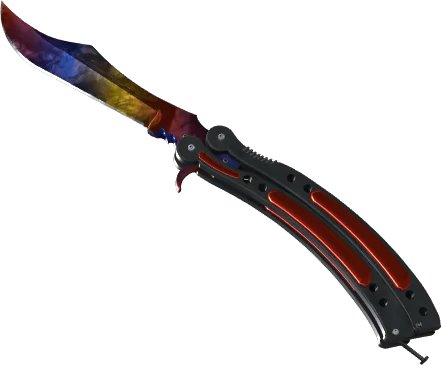
CS2 · CS:GO knife skins
Knife skins are the gold tier of every stash - the rarest, most searched and most expensive items in Counter-Strike. This guide breaks down the main knife models, the finishes and doppler phases, and how float, pattern index and StatTrak combine to set a butterfly knife price. Every figure here is illustrative and for research only.
Market position
Understand the scarcity first, and every knife price stops looking random.
Ask any collector what the most valuable items in Counter-Strike are and the answer is almost always knife skins. There is a simple reason for that: knives occupy the rare gold special-item slot inside a weapon case, and that slot only appears in roughly one out of every four hundred openings. Because supply is throttled at source while demand for a satisfying inspect animation never really drops, melee finishes sit permanently at the top of the CS2 skin economy.
Unlike a rifle finish, which has a single collection and a fairly narrow price band, a knife is a stack of independent variables. The same butterfly knife model can appear with a dozen finishes, each finish rolls a float and a pattern index, and the whole thing can be StatTrak or not. Multiply those together and almost every high-end knife on the market is close to unique, which is exactly why they hold value and why researching one before you buy pays off.
Models
There are around two dozen knife models in CS2. Below are the ones players search for most, from the entry-level shapes to the flagship blades that anchor the whole market.
| Model | Style | Relative demand | Illustrative entry price |
|---|---|---|---|
| Karambit | Curved claw blade | Very high | $180+ |
| Butterfly Knife | Flip-open balisong | Very high | $170+ |
| M9 Bayonet | Long tactical blade | High | $150+ |
| Bayonet | Classic rifle bayonet | High | $120+ |
| Talon Knife | Compact curved blade | High | $140+ |
| Skeleton Knife | Skeletonised handle | Medium-high | $160+ |
| Gut / Falchion / Shadow Daggers | Budget shapes | Entry level | $60+ |
Featured knives
The butterfly knife is the flip-animation favourite of the game. Two finishes below show how the same model can sit at very different price points depending on finish, float and pattern.
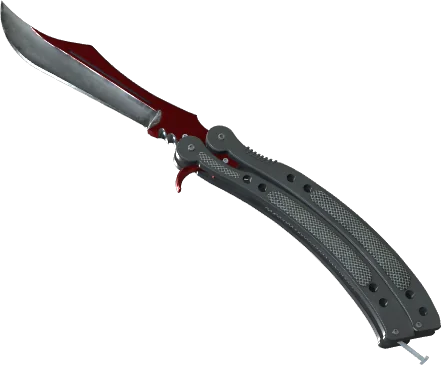
Every weapon case carries a rare special-item slot with roughly a 1 in 400 chance per opening, and knives fill most of it. That single number explains why a butterfly costs as much as it does - no amount of demand can speed up how quickly new copies enter circulation.
Finishes
The finish is the single biggest driver of a knife's identity. These are the families collectors chase, and where the phase and pattern lottery lives.
Fade grades a smooth gradient by fade percentage, so a 100% Fade sells above a 80% one. Marble Fade scatters red, blue and yellow in a fixed layout - the Fire and Ice pattern is the crown jewel.
Doppler and Gamma Doppler split into Phase 1 to 4 plus the rare Ruby, Sapphire and Black Pearl. The phase you roll is set by pattern index and can multiply the price several times over.
Chroma-family finishes like Autotronic, Marble Fade and Damascus Steel lean on metallic sheen rather than colour spread, giving a darker, more uniform look that many players prefer.
A blued-steel finish graded almost entirely on pattern. Blue-heavy seeds - especially the famous blue-gem patterns - turn an ordinary knife into a collector trophy.
Painted finishes where placement matters: a centred heart on Slaughter or a tight web cluster on Crimson Web commands a premium over a scattered roll.
A plain, un-painted knife. Vanilla blades have their own steady demand because they show the raw model cleanly and never depend on the finish lottery.
The variables
Three hidden values sit behind every knife listing. Learn what each one does and you can read a price instead of guessing at it.
Float (wear) is a hidden number between 0 and 1 that maps to the five wear grades - Factory New, Minimal Wear, Field-Tested, Well-Worn and Battle-Scarred. Lower floats look cleaner and usually sell higher, and on some finishes an extreme low float becomes a headline feature in its own right.
Pattern index (also called the paint seed) is a separate 0 to 999 value that decides how the finish is laid out on the blade. It is the reason two knives with the same float can differ wildly: pattern is what turns a normal Case Hardened into a blue gem, sets your Doppler phase and controls Fire and Ice on a Marble Fade.
StatTrak adds a live kill counter and normally a moderate premium over the identical non-StatTrak knife. The size of that premium varies by finish - for some prized phases and patterns, collectors actually prefer the plain version because it keeps the finish uncluttered.
Pricing
Put the variables together and a knife price is really a stack: model sets the floor, finish sets the band, then float, pattern and StatTrak push the individual copy up or down within it. The table shows how the same idea plays out across a few example knives.
| Knife | Finish | Wear range | Illustrative price |
|---|---|---|---|
| Butterfly Knife | Marble Fade | Factory New | $1,450 - $2,900 |
| Butterfly Knife | Autotronic | Minimal Wear | $980 - $1,700 |
| Karambit | Doppler (Phase 2) | Factory New | $780 - $1,500 |
| M9 Bayonet | Fade | Factory New | $420 - $780 |
| Bayonet | Case Hardened | Field-Tested | $150 - $2,400 |
| Shadow Daggers | Damascus Steel | Field-Tested | $60 - $110 |
Notice the Case Hardened band: a scattered pattern sits near the bottom while a blue-gem seed drives the same knife to the top - pattern index alone.
Confirm you are 18+ and continue to the external case opening platform, or keep researching float and pattern here first - the choice is yours.
FAQ
Knife value is driven by five things: the model, the finish, the wear (float), the pattern index and whether it carries StatTrak. A Factory New butterfly with a rare fade pattern and a low float can be worth many times a Battle-Scarred copy of the same knife.
The Butterfly Knife has a distinctive flip-open animation and a compact silhouette that many players find the most satisfying inspect in the game. High demand plus the same rare gold-slot scarcity as every other knife keeps butterfly prices near the top of the market.
Fade is a smooth two or three colour gradient graded by fade percentage. Marble Fade scatters red, blue and yellow in a fixed but randomly rotated layout, with patterns like Fire and Ice trading at a premium. Doppler is a phase finish - Phase 1 to 4 plus Ruby, Sapphire and Black Pearl - where the phase you roll changes the value.
Float is a hidden 0 to 1 value that sets visible wear from Factory New to Battle-Scarred. Pattern index (or paint seed) is a separate 0 to 999 number that decides how a finish is laid out, which is why two identical-float knives can look and sell very differently.
StatTrak adds a kill counter and usually a moderate premium over the non-StatTrak version of the same knife, finish and wear. The size of that premium depends on the finish - for some sought-after phases collectors actually prefer the plain version.
Knives sit in the rare gold special-item slot of a weapon case, with a roughly 1 in 400 chance per opening. You can also buy a specific knife directly on the Steam or third-party markets, which is the only way to control exactly which model, finish, float and pattern you receive.
Keep exploring
This link opens an external CS2 case-opening platform. Tick both boxes to confirm you are of age and accept the terms, then continue.